
Gas-Based Fire Suppression Systems
In a server room, a data centre or a switchgear room, water does as much damage as the fire. Spray a rack of live equipment and you’ve turned a small incident into a total write-off. That’s the problem gas-based fire suppression solves. It floods the room with a clean agent( non conductive gas) or an inert gas that puts the fire out in seconds and leaves no residue, so your equipment survives the save.
These systems protect the spaces where downtime and lost data cost far more than the building itself. They’re also the systems most often installed once and forgotten, right up until a discharge that doesn’t hold, or an inspection that fails.
ZAP FIRE designs, installs and maintains gas suppression systems for data centres, industrial and institutional clients. We’re headquartered in Gurugram and we run projects for clients across India. We’ve done this since 2008, and we cover the whole job, from agent selection and concentration design through to the annual tests that prove the system still fires.
What a gas suppression system includes
A total-flooding gas system is a chain of parts that has to act in the right order, fast:
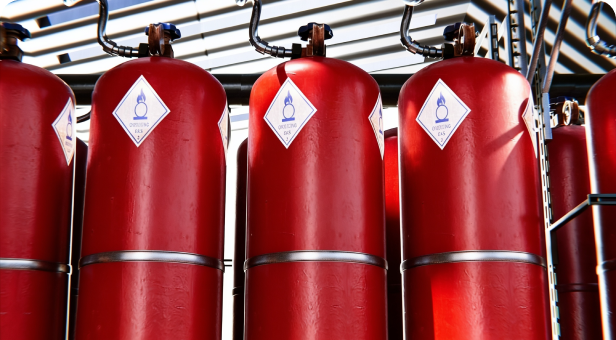
Agent cylinders and manifold
High-pressure cylinders, single or banked on a manifold, holding enough agent to flood the protected room.
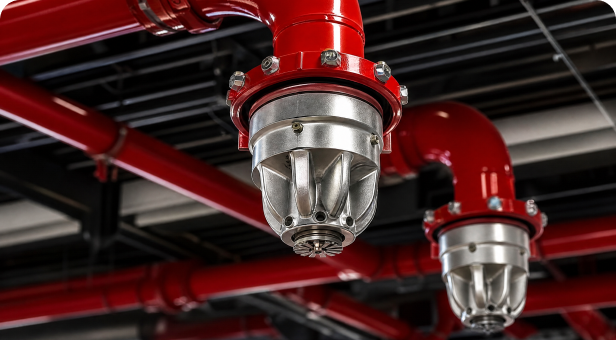
Discharge nozzles and piping
Engineered pipe runs and nozzles that spread the agent evenly across the space within seconds.
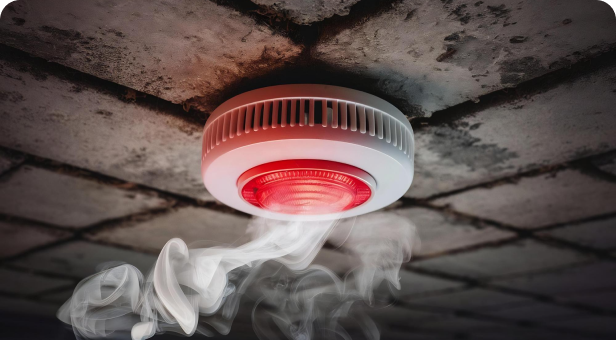
Detection
Cross-zoned smoke and heat detection that confirms a real fire before release, so the system doesn't dump agent on a false alarm.
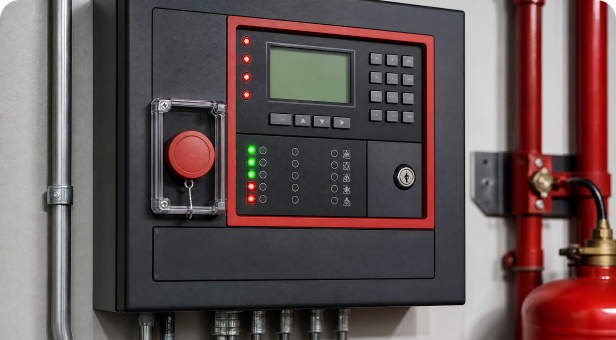
Release and control panel
The dedicated panel that reads the detection, runs the countdown and fires the system.
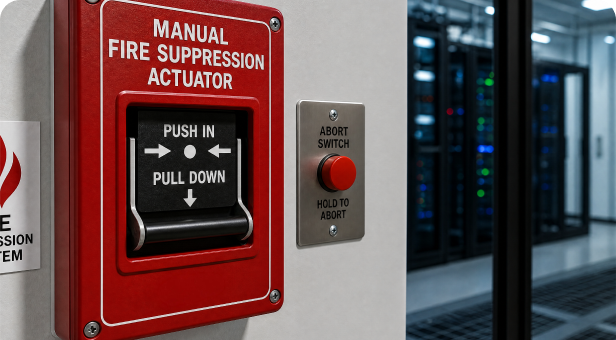
Manual release and abort stations
Manual actuators to trigger a discharge, and abort switches to hold it while people clear the room.
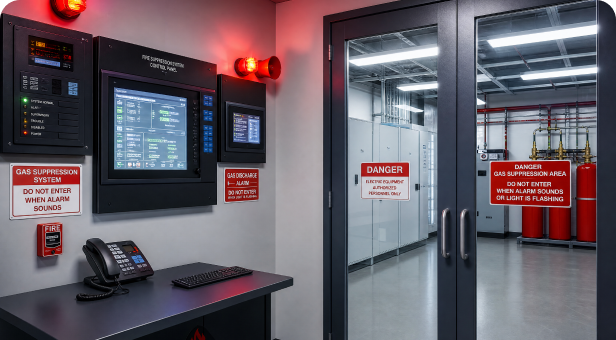
Alarms and signage
Sounders, strobes and discharge warning signs, so nobody is inside when the gas drops.
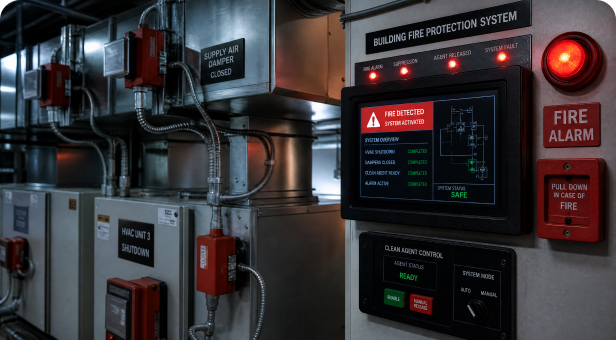
Auxiliary shutdowns
Interfaces that trip the HVAC, close dampers and shut down equipment so the agent stays in the room.
The agents we work with
We design around the agent that fits your room and the people who work in it:
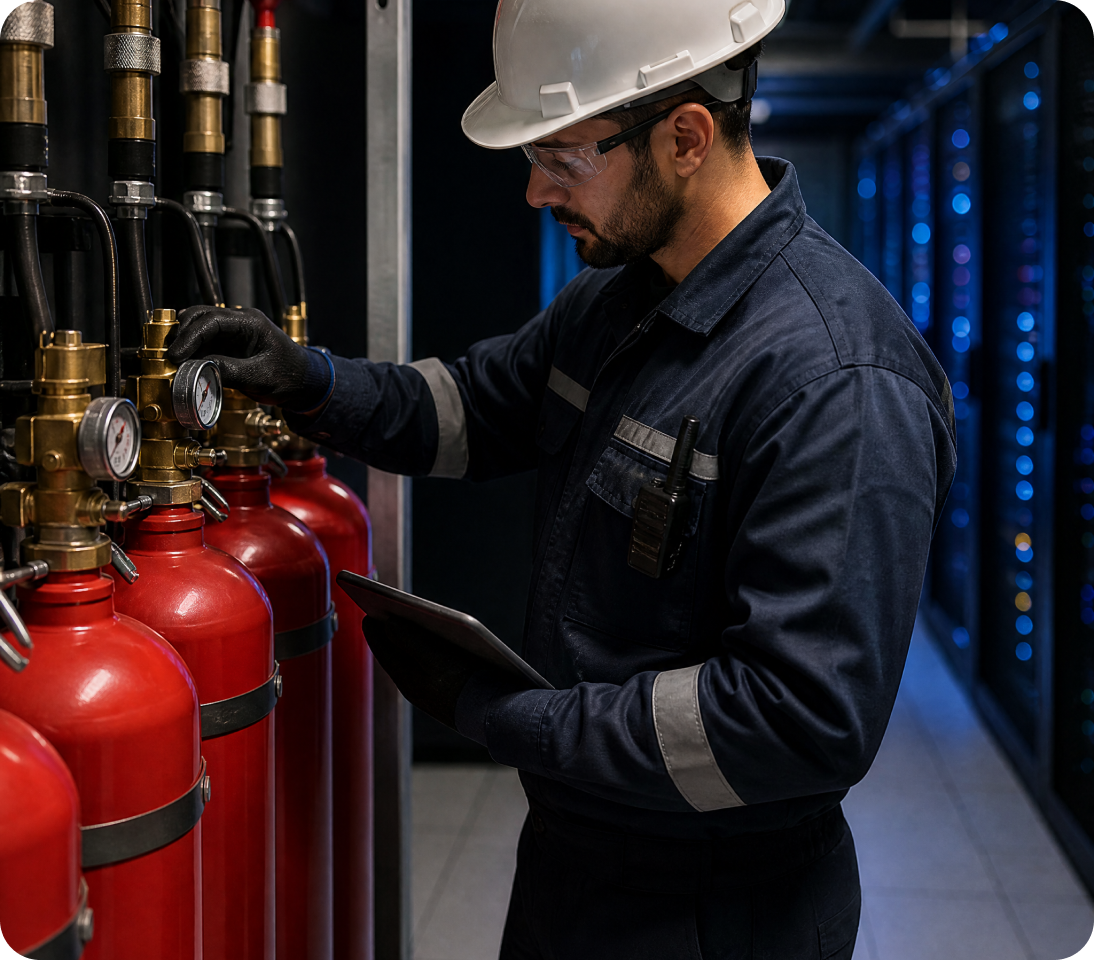
Water-based suppression is off the table in these rooms. It conducts electricity and wrecks the very equipment you’re trying to protect.
01
FM-200 (HFC-227ea)
A halocarbon clean agent that suppresses fire by absorbing heat. A fast, compact agent that’s safe for occupied spaces like staffed server rooms.
02
NOVEC 1230 (FK-5-1-12)
A clean agent stored as a liquid, with the lowest environmental footprint of the group. Non-conductive and residue-free, suited to data centres and high-value electronics.
03
Inert gas (Inergen / IG-55)
Nitrogen and argon blends that drop oxygen below the level fire needs, while staying breathable for anyone still in the room.
04
CO2.
A cost-effective flooding agent for unoccupied spaces only, since it works by removing oxygen. We design it with strict evacuation and lockout controls.
Concentration and enclosure integrity
A gas system only works if the room holds the gas. NFPA 2001 requires the agent to stay at its design concentration for at least 10 minutes after discharge, long enough to put the fire out for good. If the room leaks through unsealed cable entries or gaps under doors, the agent drains away and the fire can reignite the moment it’s gone.
That’s why we run a room integrity test, the door fan test, on every total-flooding system. It measures how tightly the enclosure holds pressure and predicts how long the agent will stay put. We seal what needs sealing before we sign off, and we re-check it under AMC, because rooms change as cables and equipment get added.
A clean agent system that discharges into a leaky room empties your cylinders and saves nothing. ZAP FIRE runs the door fan test so your room actually holds the agent long enough to work.
Services we provide
Gas suppression is precision work, and we cover every stage of it with our own engineers and crews.
After a discharge, or every year at the cylinder weigh-in, the question never changes: will it fire when you need it? A ZAP FIRE AMC makes sure of it, with the functional test on record. Email
Built to Indian and international codes
We design and install to the codes that govern gaseous suppression:
- IS 15493. The Indian standard for gaseous fire extinguishing systems.
- NFPA 2001 The clean agent standard covering FM-200, NOVEC 1230 and the inert gases.
- NFPA 12 The standard for CO2 systems.
- ISO 14520The international standard for gaseous fire extinguishing in occupied spaces.
- NBC 2016, Part 4 The national fire and life safety code that ties it together.
Designing to these is about more than approval. It’s what keeps an inert system breathable for the people in the room, and keeps a CO2 system from discharging while anyone is still inside.
Why building owners choose ZAP FIRE
These systems sit silent for years and then have to perform once, perfectly. That’s the standard we build and maintain to. Here’s what you get with us:
Agent matched to the room
We pick the gas around your space and the people in it, not a one-size default.
Room integrity built in
Door fan testing on every total-flooding job, not an afterthought once the cylinders are up.
One team from design to AMC
The people who design your system are the people who maintain it.
In-house engineers
Trained on clean-agent and inert-gas systems, not general site labour.
ERP-tracked service
Every cylinder weigh, functional test and integrity check logged and ready.
A partner since 2008
Turnkey gas suppression delivered across India.
Frequently asked questions
Talk to ZAP FIRE
Get a Comprehensive Site Survey
- ( +91 97173 04877)
- 0124 4931885
- info@zapfire.org / amit@zapfire.org
Your servers and switchgear are worth far more than the gas that protects them. Let ZAP FIRE design and maintain the suppression that keeps them standing.