
In a data centre or an archive, the sprinkler system meant to save the building can destroy what’s inside it. One sprinkler head knocked by a forklift, or a fitting that quietly fails, and a standard wet system pours water over racks of servers or shelves of irreplaceable records. A pre-action sprinkler system is built to stop exactly that.
It keeps the pipework dry and supervised, and it won’t let water in until a separate detection system has confirmed a real fire. Even then, water sprays only from the heads that open in the heat. Accidental discharge, the thing that keeps every data centre manager up at night, is designed out.
Zap Fire designs, installs and maintains pre-action sprinkler systems for data centres, industrial and institutional clients. We’re headquartered in Gurugram and we run projects for clients across India. We’ve done this since 2008, and we handle the full system, from the interlock design through to the valve trip tests that prove it works.

A normal wet sprinkler holds water in the pipes at all times, ready to flow the instant a head opens. That’s fast, but it also means a damaged head or a cracked fitting leaks water straight away. A pre-action system puts two safeguards in front of the sprinklers.
First, the pipework stays empty, filled instead with supervised air or nitrogen under pressure, with a pre-action valve holding the water back at the riser. Second, a fire detection system of cross-zoned smoke or heat detectors has to trip before that valve opens and lets water into the pipe. Only after the pipe is charged, and a sprinkler head opens in the heat, does water actually discharge, and only over the fire itself.
A pre-action system is a sprinkler network and a detection system working as one:
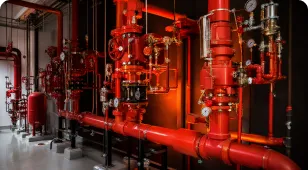
The valve at the riser that holds water out of the pipework until the detection system tells it to open.
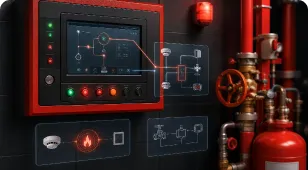
The panel that reads the detection, runs the interlock logic and trips the valve.

Smoke and heat detectors that have to confirm a fire before any water is allowed in, cutting out false trips.
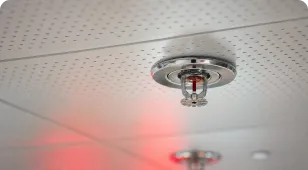
Heat-activated heads that open only over the fire, so water never reaches anywhere it isn't needed.
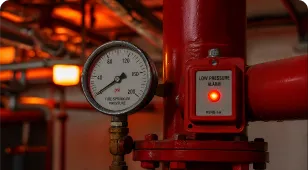
A compressor or nitrogen generator keeps the dry pipework pressurised, and a low-pressure alarm flags any leak. Nitrogen also slows pipe corrosion.
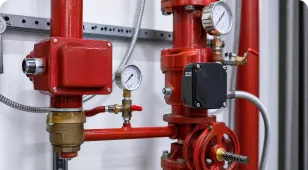
Pressure, tamper and flow switches that monitor the system and report its state to the panel.

Fed from your fire pump room and ring main, sized to the protected area.

Water enters the pipe when either the detection system or a sprinkler head activates. The quickest to deliver water, for spaces that lean towards fast response.
Water enters the pipe when the detection system trips, then discharges as heads open. The common choice, balancing speed with protection against accidental flow.
Water enters only when both the detection system and a sprinkler head have activated. The strongest guard against accidental discharge, and the usual pick for data centres and freezer or cold storage.
There are three configurations, and the right one depends on how tightly you need to guard against accidental water:
We specify and design the interlock that matches your risk, then prove it on commissioning.
One knocked sprinkler head should never flood a room full of servers. A pre-action system makes sure it can’t, and Zap Fire makes sure the system is built and interlocked right.
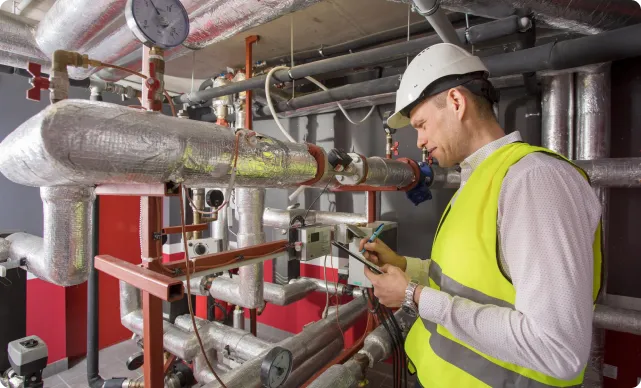
A pre-action valve that won’t trip when it should, or trips when it shouldn’t, is worse than no system at all. A Zap Fire AMC trip-tests the valve and verifies the detection on schedule.
We design and install to the codes that govern sprinkler and detection systems:
We also build to TAC norms and to any local Chief Fire Officer requirements, and we keep the drawings, test certificates and demonstration together so your Fire NOC moves without the usual back-and-forth.
We design and maintain pre-action sprinkler systems for clients across India, in spaces such as:
Data centres and server rooms
Telecom and network rooms
Archives, records rooms and libraries
Museums and galleries
Freezer and cold storage
Pharmaceutical and laboratory spaces
High-value warehousing
Critical control rooms
A pre-action system earns its keep on the day nothing happens, by not flooding a room it was never meant to. Getting that right takes design discipline. Here’s what you get with us:
We specify single, double or non-interlock around your tolerance for water, not a default.
The systems we install are made to be tested, and we test them.
The people who design the interlock are the people who maintain it.
Trained on pre-action valves and detection, not general site labour.
Every trip test, air check and inspection logged and ready.
Turnkey fire protection delivered across India.
If water in the wrong place would cost you more than the fire, you need pre-action done properly. Let Zap Fire design and maintain it. Call 0124-4931885 or email info@zapfire.org to get started.